American moneyline odds form the foundation of sports betting in the United States, yet many bettors misinterpret them. These odds determine not only potential payouts but as well the implied probability behind every wager. Understanding their structure separates informed bettors from those making costly miscalculations. The difference between a negative and positive figure carries significant financial consequences — consequences that become clear through a systematic breakdown of how these numbers actually work.
Key Takeaways
- Negative odds (e.g., -150) indicate the favorite, showing how much you must wager to win $100.
- Positive odds (e.g., +200) indicate the underdog, showing profit earned on a $100 wager.
- Total payout always includes both your original stake and any winnings earned.
- Convert odds to implied probability: positive uses 100÷(odds+100); negative uses (-odds)÷(-odds+100).
- Break-even percentages matter: +200 requires 33.33% wins; -150 requires 60% wins to stay profitable.
What Are American (Moneyline) Odds?
American odds, similarly known as moneyline odds, serve as the standard format for expressing betting probabilities in the United States. This system assigns numerical values to every possible outcome, distinguishing favorites from underdogs through positive and negative designations.
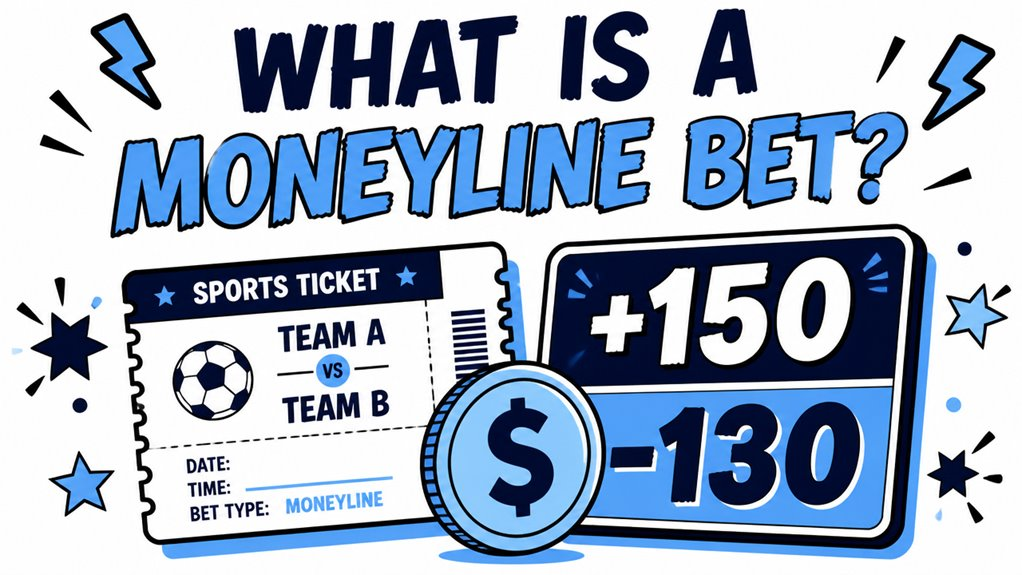
Negative odds identify favorites, indicating the amount a bettor must wager to generate $100 in profit. For instance, odds of -150 require a $150 bet to yield $100. Conversely, positive odds represent underdogs, reflecting the profit earned on a $100 wager. Odds of +200 return $200 profit on that same $100 stake.
Expressed in multiples of 100, American odds provide a structured, consistent framework for evaluating betting risk and reward. Recognizing whether odds are positive or negative is fundamental to determining any wagering opportunity accurately.
Positive vs. Negative Odds: What’s the Difference?
Building on the foundational framework of American odds, the distinction between positive and negative values carries significant practical weight for bettors. Positive odds identify odds for underdogs, signaling how much profit a $100 wager generates — +200 odds mean a $200 return. Negative odds represent odds for favorites, indicating what sports bettors must bet to win $100; -150 requires a $150 wager.
The absolute value directly reflects perceived probability. Steeper negative odds suggest dominant favorites, while larger positive odds indicate lower win likelihood. To convert American odds into implied probabilities, bettors apply distinct formulas: positive odds use 100 ÷ (odds + 100), while negative odds use (-odds) ÷ (-odds + 100). These calculations allow bettors to assess whether potential returns justify the associated risk.
How to Read Moneyline Odds Step by Step
Reading moneyline odds step by step begins with identifying the sign attached to the number. A negative number signals the favorite, indicating how much must be wagered to win $100. A positive number identifies the underdog, revealing profit earned on a $100 bet.
For example, odds of -150 require a $150 bet to win $100, while +200 odds mean a $100 bet would win $200 in profit. The total payout includes the original stake plus winnings.
American odds likewise reflect the implied probability of an event occurring. Negative odds indicate higher probability; positive odds suggest lower probability. Accurately interpreting these figures allows bettors to assess risk, calculate potential returns, and make strategically sound wagering decisions.
How Much Can You Win With American Odds?
How much a bettor can win with American odds depends entirely on whether the odds are positive or negative. Positive moneyline odds indicate profit earned per $100 wagered, while negative odds reveal how much you need to stake to win $100.
| Odds | Wager | Much You’ll Win |
|---|---|---|
| +200 | $100 | $200 profit ($300 total) |
| -150 | $150 | $100 profit ($250 total) |
| +300 | $100 | $300 profit ($400 total) |
With plus odds, a winning bet returns the original bet plus profit. With negative odds, larger stakes yield smaller returns. The break-even percentage further explains value — +200 odds require a 33.33% win rate, while -150 odds demand 60% to remain profitable.
Convert American Odds to Decimal and Fractional Formats
Converting American odds to decimal and fractional formats allows bettors to compare lines across sportsbooks that display odds differently. Both conversions are straightforward and commonly used in sports betting analysis.
For decimal odds, positive American odds divide by 100, then add 1. For example, +200 becomes 3.00, reflecting a total payout of $3.00 per dollar wagered. Negative American odds use 100 divided by the absolute value, plus 1; -150 converts to 1.67.
To convert to a fraction, positive American odds divide by 100 and simplify — +300 becomes 3/1. Negative American odds require dividing 100 by the absolute value; -220 becomes 5/11. Decimal odds always represent total payout including the original stake, making cross-format comparisons precise and efficient.
Turn Moneyline Odds Into a Break-Even Percentage
Beyond format conversions, American odds carry an implicit probability that bettors can extract through break-even percentage calculations. This metric reveals the minimum winning percentage required before a bet generates profit.
For positive odds, bettors use the formula: 100 ÷ (odds + 100). A +300 line produces a 25% break-even percentage, reflecting the increased risk tied to underdog wagers. For negative odds, the formula shifts to: |odds| ÷ (|odds| + 100). At -150, the break-even percentage reaches 60%, illustrating the higher winning percentage favorites demand.
Comparing these figures against bookmaker-assigned probabilities exposes genuine value opportunities. When a bettor’s assessed probability exceeds the break-even percentage, the wager carries a positive expected edge worth pursuing systematically.
How Sportsbooks Set and Adjust American Odds
Sportsbooks construct opening lines by synthesizing team performance metrics, injury reports, historical matchup data, and anticipated betting patterns into a single number designed to attract balanced wagering on both sides.
Four key factors drive how American odds shift after release:
- Balance the action — Books adjust odds when one side receives disproportionate betting volume.
- Significant news — Injuries or trades immediately alter how the market prices each team.
- Historical data — Past matchup trends inform both opening and adjusted lines.
- Profit margins — Vigorish embedded within American odds guarantees sportsbooks profit regardless of outcome.
Discrepancies across sportsbooks reflect differing risk management strategies and individual betting patterns each book encounters. Maintaining a balanced book remains the central objective, protecting profit margins while accurately reflecting each team’s perceived probability of winning.
American Odds Across Different Bet Types
While sportsbooks adjust American odds in response to market forces, those same odds operate differently depending on the bet type applied. In moneyline wagers, betting odds directly indicate which team to win, with a plus sign marking the underdog and a minus sign identifying the favorite. A bettor evaluating risk on a favorite must wager more to secure a smaller return, while backing an underdog yields greater profit relative to stake. In over-under bets, American odds attach to projected totals rather than team outcomes. Parlay structures combine multiple odds, demanding every bet will win for any payout, amplifying both risk and reward. Prop bets carry distinct American odds tied to specific in-game events, reflecting varied probability evaluations beyond standard team-based markets.
Common Mistakes When Reading Moneyline Odds
Misreading moneyline odds remains one of the most persistent errors among bettors, often stemming from basic sign confusion. At American sportsbooks, distinguishing between fractional implications of each sign is critical.
Common mistakes include:
- When odds are negative, bettors assume higher payouts; -150 means risking $150 to win $100, not the reverse.
- When odds are positive, bettors treat them as guaranteed wins; +200 simply means a $100 bet nets $200 if successful.
- Ignoring break-even percentage causes long-term losses; -110 odds require winning 52.38% of bets just to break even.
- Misjudging “pick em” lines limits understanding of available betting options when no clear favorite exists.
Recognizing these distinctions transforms how bettors evaluate positive odds, negative odds, and overall wagering strategy.