Point spread betting represents one of the most widely used wagering formats in sports gambling. It introduces a numerical handicap designed to level the playing field between two mismatched opponents. Understanding how spreads work separates informed bettors from those making costly errors. The mechanics behind this system are more intricate than they first appear.
Key Takeaways
- A point spread bet involves an artificial handicap applied to the favored team to level the playing field between two unevenly matched teams.
- The favorite must win by more than the spread, while the underdog can lose by less than the spread or win outright.
- A negative number identifies the favorite, while a positive number identifies the underdog in point spread betting.
- A push occurs when the final score margin equals the spread exactly, resulting in the bettor receiving their original stake back.
- Sportsbooks use point spreads to evenly distribute betting action on both sides and effectively manage their financial risk.
What Is a Point Spread Bet?
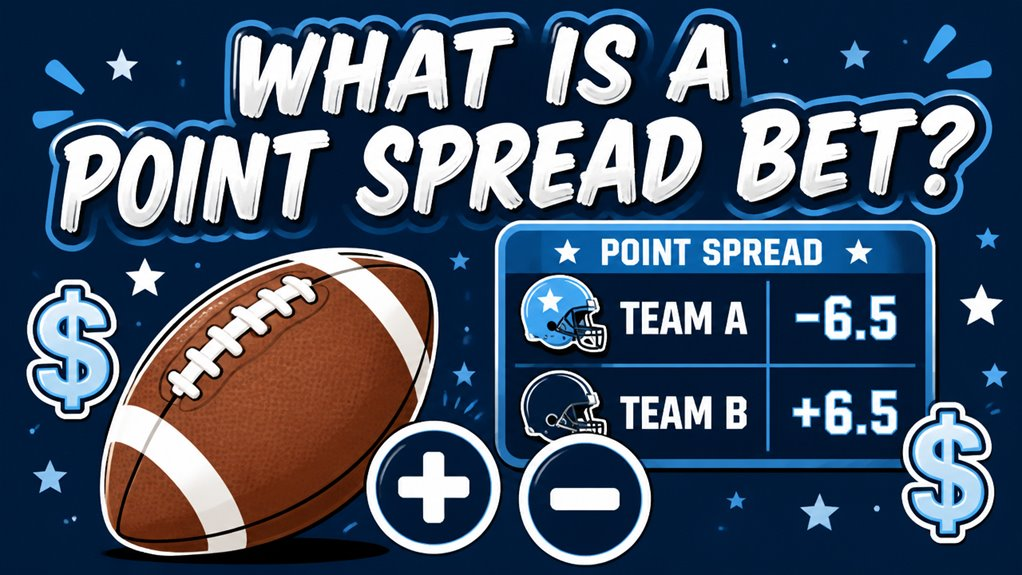
A point spread bet is a wager structured around an artificial handicap applied to the favored team, requiring it to win by a margin exceeding a specified number of points rather than simply winning outright. In sports wagering, odds makers assign a negative spread to the favorite and a positive spread to the underdog, effectively leveling competitive imbalances. To cover the spread, the favorite must surpass the designated margin of victory, while the underdog can lose by fewer points than the spread or win outright. The final score determines whether either side covers. This structure distributes betting action evenly across both sides, allowing sportsbooks to manage financial risk while collecting a margin on losing point spread bets.
How to Read a Point Spread
Reading a point spread requires understanding the numerical notation assigned to each team, where a negative number designates the favorite and a positive number designates the underdog. To bet on the favorite, the favorite must win by more points than the spread; otherwise, the bet loses regardless of the outcome. Conversely, backing the underdog means they can lose by fewer points than the spread and still cover it. The final margin determines whether a bettor wins the bet, while a push—when the margin equals the spread—results in a refunded stake. Covering the spread additionally depends on the odds attached, typically around -110, meaning the amount of money required to profit $100 is $110, regardless of which side the bettor supports.
Point Spread Examples: NFL and NBA
Concrete examples from the NFL and NBA illustrate how point spread betting functions in practice. In the NFL, a team favored at -6.5 must win by seven or more points to cover the spread. The underdog, meanwhile, can win outright or lose by six or fewer points and still satisfy betting lines. If the spread is -6 and the favored team wins by exactly six, the result is a push, prompting the sportsbook to refund all wagers.
In the NBA, a -8.5 favorite like the Celtics must win by nine or more. Conversely, a +5 underdog such as the Lakers covers by either winning outright or keeping the deficit within five points. These mechanics reflect how sportsbooks structure balanced, precise wagering conditions.
What Is a Push in Spread Betting?
When the final score difference between two competing teams exactly equals the point spread, the outcome is classified as a push. In spread betting, a push results in the bettor receiving their original stake back, with no monetary gain or loss recorded on those wagers.
| Scenario | Result |
|---|---|
| Team wins by exact spread | Push |
| Bettor outcome | Original stake returned |
| Half-point spread | Eliminates ties |
| Sportsbooks disclosure | Push possibility noted |
Sportsbooks actively disclose push possibilities to guarantee transparency in bet settlements. Half-point spreads are strategically implemented to minimize push occurrences, forcing definitive outcomes on all wagers. When a team carrying a -7 spread wins by precisely seven points, both sides of the point spread experience a push.
Point Spread vs. Moneyline: Key Differences
Beyond the push mechanic that defines certain spread betting outcomes, point spread and moneyline bets represent fundamentally distinct wagering frameworks. Each structure governs how bettors engage with the favorite, underdog, and ultimate win conditions differently.
Key distinctions include:
- Win condition: Point spread requires the favorite to win by specific points; moneyline demands only an outright winner.
- Handicapping: Spread betting balances team strength through point differentials; moneyline relies strictly on odds.
- Payout structure: Spread bets typically carry standard -110 odds; moneyline payouts fluctuate significantly by outcome probability.
- Tie possibility: Spread bets can push; moneyline produces only wins or losses.
- Sport preference: Football and basketball favor spread betting; baseball and hockey mainly utilize moneyline wagering.
How Point Spread Payouts Are Calculated
Point spread payouts hinge on the odds assigned to each side of the bet, with -110 serving as the standard benchmark across most sportsbooks. At this rate, a bettor must wager $110 to generate $100 in profit, with a successful bet returning $210 — the initial stake plus profit combined.
When positive odds apply, such as +110, a $100 wager yields $210 on a successful bet, reflecting a $110 profit. These odds fluctuations are driven by betting volume and sportsbooks’ ongoing adjustments to balance risk exposure.
A push occurs when the final score lands precisely on the spread, triggering a full refund of the initial stake with no profit or loss recorded. Understanding these calculations allows bettors to accurately assess potential returns before committing to any point spread payouts.
When Does Betting the Spread Make Sense?
Identifying the right circumstances for a point spread bet separates disciplined bettors from those who wager indiscriminately. Every betting guide emphasizes that context drives smart spread decisions.
Knowing when to bet the spread separates disciplined bettors from those who wager without purpose or strategy.
Key situations where betting the spread makes sense:
- Team dominance: When a team consistently scores more points than the spread suggests, backing them provides value.
- High-scoring sports: Football and basketball reduce the probability of win outright or lose scenarios, making spreads more predictable.
- Key numbers awareness: In NFL betting, understanding margins around 3 and 7 directly influences the outcome of a game.
- Public inflation: Overvalued favorites create underdog opportunities at favorable spreads.
- Competitive matchups: Spread in sports betting excels when games appear closely contested rather than one-sided.
Disciplined bettors analyze these factors before committing to any bet.
Common Point Spread Mistakes to Avoid
Even disciplined bettors fall into predictable traps when wagering on point spreads. Ignoring the juice distorts true profit calculations; standard -110 odds mean risking $110 to win $100, quietly eroding margins over time. Chasing key numbers like 3 and 7 without evaluating genuine value forces bettors into action where none exists. Monitoring line movement is critical, as shifts reveal where sharp and public money flows before kickoff. Bundling spread bets into parlays compounds risk significantly, since every leg must win for any return. Perhaps most damaging is surrendering to public narratives, which inflate lines and obscure real value. Understanding what spread betting means requires recognizing these patterns before they silently cause bettors to consistently lose over a full season.